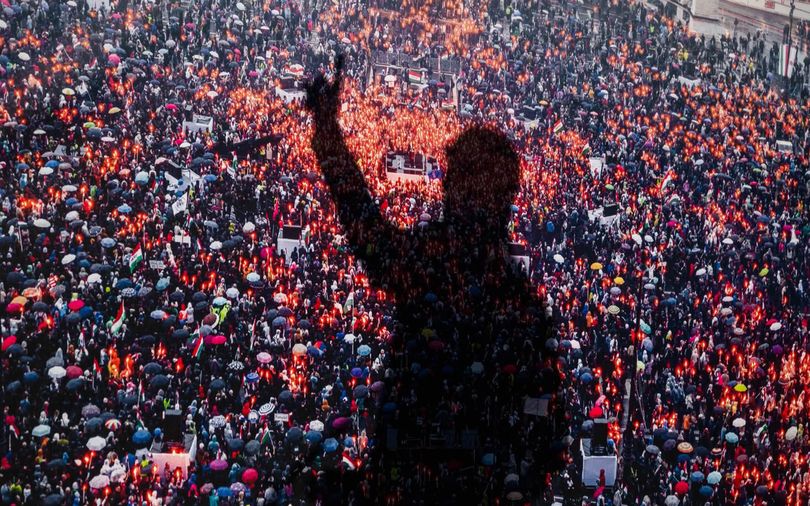

Even hooligans pouring out of a football match can expect a tougher
police presence than that hard core of forty to fifty people who led a
crowd of several thousand to storm the headquarters of Hungarian State
Television (MTV). For hours, a symbolic water cannon was all police
had to control a gathering crowd on Szabadsag ter that was busy
setting fire to cars and hurling paving slabs at the MTV building. By
1am, the building stood open to any curious passer-by who wanted to
walk inside.
A riot control van that fell into the hands of the crowd became a
symbol of police passivity, and for a while it looked as if the two
police officers inside would face a lynching. Jozsef Petretei, the
minister for public order, spoke with astonishing resignation on
various television channels. He continued to claim that "there are
enough police officers on the scene," and that "we are in control of
the situation" - even when it was clear that things were running out
of control. This was the case even when the crowd turned its
attentions to the Soviet war memorial and when the American embassy
was left to fend for itself, a situation which threatened diplomatic
difficulties for the government. Petretei offered his resignation that
evening, but Gyurcsany did not accept it.
For the time being, there is no answer to the questions of whether the
protesters were being afforded political assistance, whether they had
been provoked, or whether politicians were worried that they would be
seen as overreacting if the police reacted to events in a more
aggressive way. Everyone, regardless of party allegiance, reacted with
initial astonishment. It was this that led to a five-party declaration
on Tuesday that condemned violence. Anti-government demonstrations
continued throughout that day, however, and had spread all round the
country by late evening.
There had been talk of taking politics to the streets for months. But
nobody had expected that pictures of burning cars in Hungary, 'the
island of peace', would be flashed around the world 16 years after a
peaceful regime change in the country.
There are several ways of reading events. For a while it seemed clear
that everything that happened from Sunday afternoon onwards was in the
interests of Ferenc Gyurcsany, the very target of the attacks. The
escalating violence might, for example, inspire a sense of solidarity
for the government or legitimate later harsh police measures. Another
argument is that the events gave the PM column inches with which to
explain his reform plans in a media which has thus far concentrated on
their negative consequences. Indeed, it was this thinking that caused
the markets to react positively to the first signs of disturbance. On
Monday, before the MTV siege, the forint firmed up after an initial
flutter. Tuesday trading showed few signs of panic. Though both the
stock market and the forint had fallen by the end of the day, neither
move was dramatic.
"A democratic state governed by laws needs clean, transparent and open
political competition," wrote Gyurcsany in 2003 in his 2003 essay
'Let's dare'. The PM's comments have seemed rather different since
last Sunday, but he has still managed to present himself as a fallible
politician who is nonetheless working for his country's interests. He
has presented himself as someone who does not always tell the truth -
or, as he said in an interview, someone "who did not reveal every
detail of the truth," - but he did this to serve a higher purpose -
that of bringing about genuine reforms. The ends justify the means, he
seemed to argue, and now that he had won the election, he could be
clean once again. In this view, the PM's survival is desirable: he
stands as the guarantor of the convergence programme submitted to
Brussels last week.
The other reading of events is that they were all orchestrated by an
opposition which has failed to get to grips with Gyurcsany over recent
years. Fidesz has had the speech in its possession for months, it is
claimed, and it planned to unveil it to the public at a rally on 23
September. Gyurcsany got wind of this and spiked the plan by leaking
the speech himself ahead of the rally.
The opposition did indeed lose control of events on Monday evening,
after spending weeks building up its local election campaign. Fidesz's
election campaign was built around the allegation that the government
had lied, promising one thing in spring, doing another now. This
message has been strengthened by certain passages from the PM's
speech, which the opposition regards as a simple confession, despite
coalition claims that context is everything. The opposition's case was
strengthened by Gyurcsany's statement that "we lied morning, day and
night," and that the prime minister frequently used the word 'kurva'
(literally 'whore', but meaning 'fucking' when used as an intensifier)
in his speech: "fucking country," "we fucked up."
Fidesz hopes the government will do badly in the local elections.
Originally, the party thought this would be the result of protest
votes cast against the government's cuts package. This line was
reinforced by the claim that the elections due on 1 October would be a
"third round" to the parliamentary elections held earlier in the year.
The argument was that a local election defeat for the coalition would
serve as proof of the government's illegitimacy, which would have
quasi-legal consequences for the government. Viktor Orban, the
president of Fidesz, reacted to developments at the beginning of the
week by saying that the local elections would be a kind of referendum
leaving the Socialist Party with no choice but to abandon their prime
minister "along with his cuts package." Orban said Gyurcsany's
government would have to be replaced by a government of experts.
But the opposition's belief that the government will fall looks to be
little more than a dream. The President of the Republic did not take
the idea seriously. Laszlo Solyom confined himself on Monday to
warning politicians - and Gyurcsany in particular - of the moral
consequences of their actions. The prime minister should apologise to
voters for labelling the political elite's actions over the past 16
years a simple lie and for undermining their faith in democracy. By
Tuesday, however, as events on the streets became more violent, the
president emphasised the importance of restoring order. He made it
clear that the MTV siege was a simple criminal act, "wholly
unjustified," and he rejected any parallels between the week's events
and the 1956 revolution.
Gyurcsany's chances of survival were greatly improved by the
determined support he received from the Free Democrats, his junior
coalition partner. The Free Democrats had no thought of walking out of
the coalition, and nobody in the coalition made any such suggestion -
at least in public. Such a move, it was felt, would primarily help
the opposition. Socialist MPs see Gyurcsany as a positive hero whose
tough words were designed only to shake up his party colleagues,
forcing them to sign up to the reform programme.
Yet even if there is no government crisis, the moral consequences of
the past week's events are still important. What kind of consequences
might Gyurcsany's speech have for a growing generation's sense of
morality? A speaker at a rally in a provincial city said: "How can I
now tell my students not to cheat and not to steal?" And politicians
must also take the blame for the way in which common football
hooligans were able, if only for a few hours, to become genuine
political actors. One wounded protester said that evening that he had
waited 16 years for this moment. On 18 September, he finally felt like
he was living 23 October 1956. The date is symbolic: 17 years earlier,
in 1989, the roundtable discussions that brought down the shutter on
the previous regime were finally concluded.
JÁNOS DOBSZAY