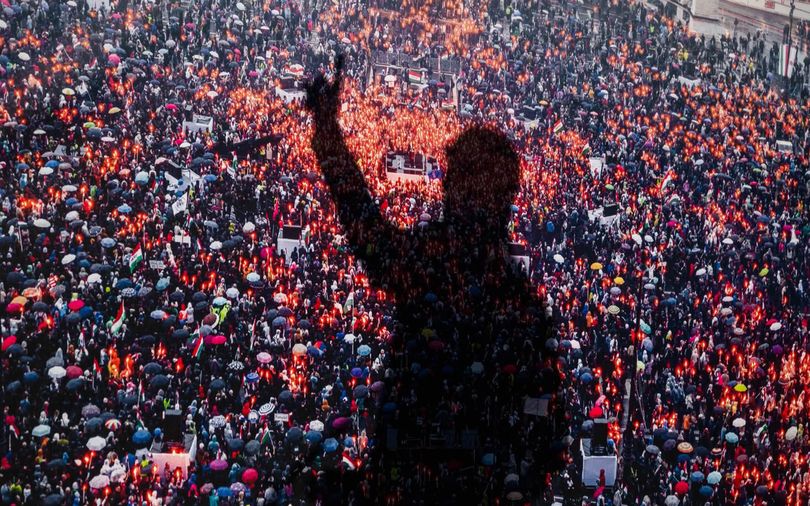

The leaders of the two main groups behind the Kossuth ter
demonstrations, the Hungarian National Committee 2006 (MNB) and the
Revolutionary National Committee (FNB), insist the two organisations
are at one with each other, and that there no differences of opinion
between them. Andras Takacs and Jozsef Halasz claim only their groups
have the right to speak for the Kossuth ter protesters. Perhaps – but
over the past few days, other voices have been heard on the square. It
is no coincidence that Takacs's group had some explaining to do: on
Monday morning, it was not they, but another group that handed a
petition to Parliament's Civic Affairs Office.
Hungarian National Committee 2006
It is clear that the the MNB, formed last Tuesday, and the FNP, are
the two most important groups. It was Andras Takacs, a leading figure
in the demonstration, who announced the establishment of the MNB. Many
condemn Andras Takacs's leadership style. Among them is Gyorgy
Budahazy, who has become nationally known for his activities on
Szabadsag ter. In a letter, he called on protestors to „stop" Takacs,
saying his self-importance was undermining the movement, just as he
had done to the Movement for a Free Hungary.
The MNB has 13 members, but apart from Takacs, only three of them have
the right to make „political representations." They are Tamas Molnar,
who walked out of the far-right Jobbik party at the outbreak of the
demonstrations, and who has called the police state terrorists, Dr
Karoly Tamas, Dr Jozsef Halasz and Laszlo Toroczkai, the
twenty-something leader of the 64 Counties Youth Movement. Apart from
them, Laszlo Gonda, a German-Hungarian mechanical engineer, and Barna
Balogh are frequently to be heard. Balogh is a spokesman for the
committee, whose aims include bringing down the Gyurcsany government,
summoning a national assembly to draft a new constitution, calling
early parliamentary elections and abolishing the 5 per cent threshold
for gaining parliamentary representation. The MNB regards Laszlo
Solyom, the president of the republic, as Hungary's highest official,
and though it is prepared to negotiate with the parliamentary parties,
it will not talk with the Gyurcsany government, which it regards as
illegitimate.
Revolutionary National Committee
The FNB has similar aims. Gyorgy Ekrem Kemal, one of its members, is
also a protest organiser. He is known to the authorities: years ago,
he was given a suspended prison sentence for carrying out activities
against the constitutional order. Maria Wittner, a Fidesz MP, is
another member of the FNB, as are Imre Korosi, the Calvinist priest
Lorant Hegedus Jr, the lawyer Laszlo Nagy and the rock musician Lorant
Schuster. The remaining leaders are an unknown lawyer, an IT
specialist and a businessman.
Group for a New Hungary
The Group for a New Hungary, which shot to fame with its petition on
Monday, does not yet officially exist. It calls for the establishment
of a temporary government and also wants a national assembly to write
a new constitution. The group gains its prestige from the presence in
its ranks of former politicians (Imre Pozsgay and Matyas Szuros), a
nationally famous architect (Imre Makovecz), and a heart surgeon
(Lajos Papp). Their position on Kossuth ter is strengthened by the
fact that the Farmers' Alliance (Magosz) regards it as the leading
organisation on the square.
Protesters call it the Makovecz group. On Monday morning, the group
handed a petition to the head of the parliamentary Civic Affairs
Office. A while later, Laszlo Gonda of the MNB emphasised that they
had had no role to play in the drafting of Makovcecz's petition. In
fact the document was not even a petition at all, he said, merely a
declaration. Seeing these tensions, Gyorgy Budahazy, who is being
sought by the police, wrote a letter to the „patriots", saying that
Takacs's group should be glad that Makovecz's group was standing by
them.
Other Hungarian Voices
Other groups on the square include the National Resurgence Movement,
which is demanding that all (or at least 193) MPs stand down, allowing
the president to call new elections.
Others seeking to profit from the demonstrations include Istvan
Csurka, who has already been heckled on the square. He aims to get in
on the ‚revolution' with the aid of his Hungarian October Committee.
The leader of MIEP said the Hungarian October Committee also wanted to
call a national assembly to write a constitution. Csurka, who has
called for a general strike, wants not only to bring down the
government, but to change the whole regime.