
On the campaign trail, Ferenc Gyurcsany is encountering all manner of
protests, but the whistling and heckling pale in comparison with what
might follow if he does not respond to a "sobering" defeat in the
elections by changing his political direction. This at least is Viktor
Orban's hope. The president of Fidesz wrote in Saturday's Magyar
Nemzet: "By the time winter comes, it will no longer be a case of the
left and the right arguing with each other, but of an embittered and
angry country facing down its illegitimate government." The former
prime minister argued: "Gyurcsany's cuts package is not a
democratically endorsed government programme, but a diktat. It is not
legitimate, so the government has no right to implement the package."
This scenario is gaining ever more currency within Fidesz. At an
election meeting last Friday, Laszlo Kover, the president of the
party's national committee, said that the October local elections
would be the last chance to send a signal to the government. Some
members of the audience responded saying that Gyurcsany should be
"pushed" out of power. But Janos Martonyi, who belongs to the party's
more moderate wing, told the weekly Heti Valasz last week that "the
time has come when principled politics demands more radical
solutions." It started to look like a scripted move when at the
weekend, several delegates at a meeting of right-wing intellectuals in
Somogy county said the time had come for Fidesz to adopt a more
radical approach. For Orban, who was also in attendance, it was
convenient that he came out of it sounding like the voice of
moderation, urging attendees to show patience. First, he said, they
should wait and see if the government would change course after the
elections.
This waiting strategy makes sense for Fidesz, since things seem to be
moving in the party's direction. The tide of protests should peak in
September. Pharmacists have already started protesting, higher
education workers and students unhappy about tuition fees are starting
to get restless, as are school teachers angry at having to teach more
classes than previously.
The government can be grateful that the trade unions have planned
their protests for October when, as Peter Konya, a trade union leader,
has said, "every employee will have seen their new, reduced salary."
Fidesz gains from its outsider role, especially while the government
is fighting the media, not the other parties. Observers say that
competition for larger audiences is pushing the media into
highlighting the negative impact of Gyurcsany's cuts package.
Fidesz's leadership has in the passed had difficulty ridding itself of
its street-fighter image. During the summer, it was suggested that
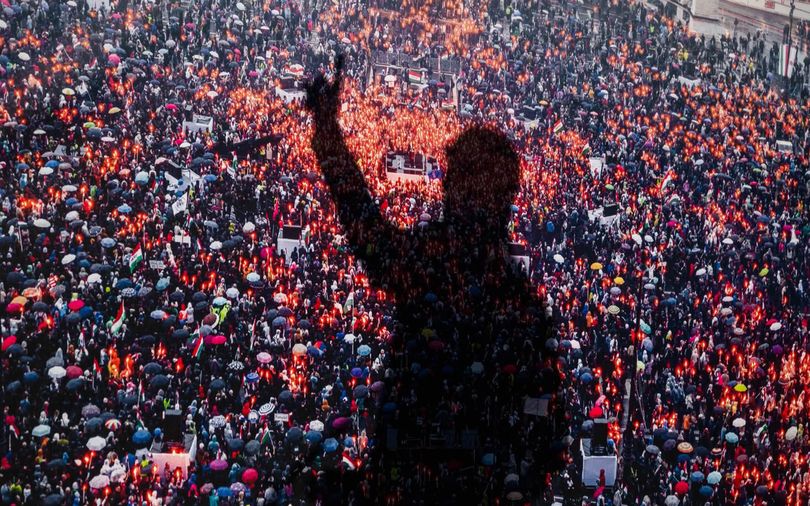
Orban had made a tactical mistake by calling a mass rally on Heroes'
Square. While extra-parliamentary parties like the Hungarian Truth and
Life Party or the Movement for a Better Hungary can gain from flexing
their muscles with a mass rally, Fidesz is a parliamentary party, and
large-scale events can put voters off.
Peter Szijjarto, the party's communications chief, recognised this
danger, telling protestors that they should "silently, and with
dignity, turn their backs on the prime minister." Admittedly, he added
that the PMs campaign tour was an open provocation. Set in that
context, therefore, it is no surprise that his call for moderation was
little noticed. The Socialists have not been able to prove that the
heckling against Gyurcsany has been centrally organised, the mere
claim that the opposition party lies behind the incidents can harm
Fidesz's cause. If voters have not forgotten the government's
promises, nor have they forgotten Fidesz's "outsourced campaigning" in
the spring, like when the party denied that it had any link with
publications criticising the government or that it had been behind a
successful attempt to hack into the Socialist Party's computer
systems.
The governing parties' outrage conceals a degree of tactical thinking
as well. The government is engaged in major reforms to social
security. Public opposition to such a package hardly comes as a
surprise, and the government was clearly expecting to see its
popularity ratings plummet in consequence. For this reason, it is
clearly wrong to see the local government elections as - in Orban's
words - "the third round of the parliamentary elections." A poor
showing for the governing coalition at the local elections would not
deligitimise the government, justifying actions like the July 2002
bridge blockades.
The claim that today shows parallels with 1956, that there is a
"revolutionary mood" in the air, is also questionable. Whatever Fidesz
would like it to be, the cause of the current bitterness is not moral
outrage, as it would be if there were a repressive regime in place.
Rather, voters are worried about their material well-being. Lack of
money can lead to radicalisation, there is not enough ammunition to
set up a real civil disobedience campaign. A real protest movement
would only emerge if the country really did face complete bakruptcy -
something the current cuts package is designed to avoid.
JÁNOS DOBSZAY